Medieval Engineers Console Commands

Medieval Engineers. I will add my Steam ID to the admin section from the Dedic console and in game I use the Medieval Master Alt+F10 and enable creative in survival. For console COMMAND LINE there is just the basic you see on the Official wiki and I never used. Update 02.017 – Peasant commands, Woodcutters. We are introducing a new command system for peasants. You can now assign different roles to the friendly AI bots (servants) and convert them to specialized peasants (woodcutter, miner, porter). Then you can mark the areas where you want them to take action.
I like what you're suggesting here. For teleporting to locations I think a more sensible way would be that, if creative mode is enabled for admins, they are simply unrestricted by fast travel rules. That way we don't have to implement complex notation for teleporting to areas. Additionally, teleporting to players by name is hard, because not all players have easily typable playernames.
A lot of them have special unicode characters in there. A better solution would be to add a 'Teleport to' button to the F3 screen. That way you don't have to type player names, and you still get the same functionality.
| Space Engineers | |
|---|---|
| Developer(s) | Keen Software House |
| Publisher(s) | Keen Software House |
| Composer(s) | Karel Antonín |
| Engine | VRAGE 2.0 |
| Platform(s) | |
| Release | Windows February 28, 2019 Xbox One April 15, 2020[2] |
| Genre(s) | Sandbox, simulation |
| Mode(s) | Single-player, multiplayer |
Space Engineers is a voxel-based sandbox game set in space and on planets. It was developed and published by Czech Republic independent developer Keen Software House. In 2013, the initial developmental release of the game joined the Steamearly access program. During the following years of active development, Space Engineers sold over one million units. In total as of 2019 the game has sold over 3.5 million copies[3][4]In May of 2015, for approximately a year and a half, the game's source code was officially available and maintained by KSH to assist the modding community.[5][6]On December 15, 2016, the game entered Beta and was later officially released on February 28, 2019.
Gameplay[edit]
Screenshot of the game demonstrating the addition of new components to an existing structure.
An astronaut mining an asteroid for resources using a hand drill
First-person view from the cockpit of a small ship.
Gameplay of Space Engineers begins with the player selecting or joining a world with specific settings, such as the number of asteroids and the available starting equipment. When creating or editing a world, several advanced options are available to change how the player will interact with the world, and how the worlds will appear. This includes changing the speed with which several tools and machines will work, the size of the player's inventory, and whether procedural generation will be used (effectively making the world infinite). Upon confirming the world settings, a loading screen appears while the world is generated. This screen consists of a random in-game screenshot as a backdrop, the game's logo, an animated loading icon, and a randomly selected message at the center. The message may be either a helpful gameplay hint, or one of many quotations concerning space, science, and/or engineering. Many of these quotes are from notable scientists such as Isaac Newton, Galileo Galilei, Albert Einstein, as well as authors such as Arthur C. Clarke.
Once in-game, the player is given control of a single astronaut (referred to as a 'Space Engineer') and a set of tools comprising a drill, a welder, and a grinder (if spawn with tools is on). Construction begins by choosing any block from the Engineer's inventory, and placing it anywhere in open space to create a new voxel grid. Additional blocks can then be added to this grid to create a structure.
Each block takes up a different amount of space, and can serve a structural, functional, interactive, and/or aesthetic purpose. Armor blocks, the most basic and common of all blocks, can be realistically damaged and deformed through collisions or the use of weapons.[7][8] Some blocks have attached keypads, which can be used to view and manipulate the status of other specific blocks attached to the structure. To be functionally connected however, and to transport materials, blocks called 'conveyors' must be used to connect the desired machines. 'Functional' blocks require power, which can be provided by solar panels or nuclear reactors attached to the same structure. While reactors must be supplied with uranium, and produce large amounts of power while active, solar panels will continually produce a low output of power when there is line-of-sight to the sun. Once being produced, power is automatically distributed throughout the entire structure and can also be stored in batteries.
Three types of structures are available: small ships, large ships, and stations. The player can toggle between placing small and large block sizes; placing a small variant of a block will create a small ship, while placing a large variant will create a large ship. If a large block is placed in such a way that it intersects terrain voxels (such as an asteroid or planetary surface), a station is created instead. Stations use the same blocks as large ships, and can be converted into large ships by disconnecting them from the terrain (though a world setting can be changed to permit unanchored stations).
The size, resource requirements, and availability of blocks depends on the type of structure they are attached to. Small ships do not allow 'large' blocks such as assemblers or refineries, whereas large ships and stations cannot use gatling guns, instead using AI-controlled gatling or missile turrets. Blocks attached to a small ship are considerably smaller and require fewer resources than those attached to large ships or stations (for example, light armor requires 25 steel plates on a station, but only one on a small ship).
Ships can be deliberately moved and rotated by a player as long as they are powered and have at least one gyroscope, thruster, and cockpit. To be able to move in any direction and then be able to stop effectively via inertia dampeners, thrusters must be placed on the structure facing up, down, forward, backward, left, and right. More gyroscopes on a ship will increase the ships ability to rotate in space, but in order for the inertial dampeners to be more effective, more thrusters must be added in each direction in which dampening is required.
Astronauts floating in space are able to move forward, backward, upwards, downwards, left, or right without restriction by using a jetpack. They are also able to rotate clockwise or counterclockwise. Astronauts and structures can also enable or disable inertial dampeners, which automatically attempt to reduce speed to zero when force is not being applied, and the required thrusters are installed.
If the player disables their jetpack within a gravitational field (either on the surface of a planet or a structure/asteroid with a gravity generator), movement is restricted to a plane perpendicular to the direction of the net gravity field(s). Vertical viewing angle is also restricted between −90 and 90 degrees, as in most first-person shooters. Ships and structures are unaffected by gravity generators unless equipped with at least one Artificial Mass block. If the player falls off a structure while within a gravity field, they will fall into space until out of range of the gravity generator, at which point the player's jetpack will automatically enable itself. However, if the player touches their feet to an asteroid or structure with no gravity present, their 'mag-boots' will enable them to walk across its surface and even around edges; though jumping will disconnect the player from the surface, and they cannot traverse the 90-degree angle between a floor and wall.
Several types of cargo ships can spawn randomly and fly through the world, which can be hijacked by the player or harvested for components. Some of these cargo ships are booby trapped to explode when the player attempts to commandeer them, and are sometimes armed with hostile gatling or missile turrets.
All place-able objects can be colored prior to placement using a slider-based GUI. The player can manipulate the hue, saturation, and value of the color to produce a very large spectrum of colors. There are 14 slots where new colors can be saved for later use within the same world. Colors can also be changed after blocks have been placed by clicking the middle mouse button while hovering over a block on the 'Color Picker' GUI.
Asteroids and planets are currently fixed in space and cannot move, however rocks/minerals that have been mined are subject to gravity and will react accordingly. Asteroids also do not currently have gravity associated with them, and can come in several basic forms including spherical, torus, and rod-shapes, as well other variations or combinations of these.
Creative mode[edit]
In creative mode, players are able to spawn unlimited resources, can instantly build tools and blocks, and are invincible.[9] Some building tools, such as symmetry mode and copying and pasting of ships, are only available in this mode. Players are also able to build and manipulate asteroids or planets using a tool known as 'Voxel Hands'. Although resources are available for collection and refinement, they are not required to create new ships or stations. Creative mode was initially the only mode available in the game. This mode eliminates the survival aspect of the game, allowing players to implement ideas quicker and easier.
Survival mode[edit]
In survival mode, players need to mine, collect, and refine various chemical elements from asteroids and planets in order to craft tools, weapons, and blocks as well as produce electricity. Resources can be mined manually using a hand drill, or by using ships with the necessary equipment. Components are produced by assembling them from raw materials; however, they can also be harvested by salvaging cargo ships. To avoid death, players must monitor their health, energy and oxygen levels. Damage can be inflicted on the player by collisions, weapons, contact with thrusters, meteor showers, or by running out of space suit energy. Collisions at higher speeds result in more damage. As the acceleration value of gravity generators stacks, damage from falling can be much more dangerous when multiple gravity generators are active. A player's health and energy can be restored using a Medical Room block, and energy can also be replenished by sitting in the cockpit of any powered structure. The development of survival mode began at the end of summer of 2013.[10]
Materials and items[edit]
In the survival mode of the game, all actions, including survival itself due to the power requirements of the space-suit's life-support system, depend on the gathering and refining of certain minerals. These minerals can be found on asteroids or planets, plundered from randomly spawned ships, or recovered from unknown signals. Raw materials are mined from deposits of ore on asteroids, and are then placed (or sent using a conveyor system) into a refinery or an arc furnace in order to refine them to be used in assemblers. The refined materials are formed into various components in the assembler which can then be used in the construction of ships or stations.
Inventories and storage[edit]

Inventories in Space Engineers are very flexible and work in a whole-ship manner rather than in an individual one. All inventories connected to a ship can be viewed from any access panel on the same ship, however inventories must be connected via conveyors and conveyor tubes in order for items to be transferred among them. Inventories of refineries and arc furnaces will automatically request items to refine from connected inventories when they get low, and will send items into an available inventory when it fills up. The conveyor sorter allows inventories to be automatically removed and sorted from and into certain inventories. Instead of a common slot system, Space Engineers uses a volumetric system, measured in litres, with every item having a certain amount of volume and every inventory a certain capacity that it cannot exceed.
Planets[edit]
Planets in Space Engineers were released on November 12, 2015, after being in development since February 2015. There are several types of planets, themed after Earth, the Moon, Mars, Titan, Europa, and an 'alien' planet.[11] All of these feature procedurally generated pirate bases, which spawn hostile spacecraft. The alien planets feature Sabiroids, hostile 6-legged, spider-like NPCs, and the Earth-like planet features wolves, hostile dog-like NPCs.
Planets are somewhat resource-rich, though extraction of useful products from the surface can be difficult. Resources are spread out, and due to planetary gravity and the inefficiency of ion engines within the atmosphere, the player must build ground-based alternatives.
Atmospheric flight is possible even on worlds with oxygen-deprived atmospheres. In order to leave a planet, the player will need to use hydrogen engines with sufficient fuel or build a hybrid spacecraft with atmospheric engines (for liftoff) and ion engines (upper atmosphere to space).
Hybrid surface-to-orbit craft are considerably heavier than their space-only counterparts, but can be built compact enough to fit inside a standard hangar.
Unknown signals[edit]
On August 17, 2017, 'unknown signals' were added to survival mode. These signals spawn randomly within a certain range of the player, and indicate the position of a small probe via a GPS coordinate and a repeating tone. Each probe contains components and can be disassembled, effectively preventing the player from encountering a catch-22.[further explanation needed]
Each probe also possesses a button, which when pressed has a chance to reward the player with a collectible skin, similar to a loot box. The skin can be for the player character's helmet, suit, boots, or tools, and can be traded or sold on the Steam Market. Each skin can be obtained for free in-game, with the exception of three sets: the Veteran Set, which was awarded to players who had owned the game before and played between August and September 2017; the Medieval Set, which is awarded to players who also own Medieval Engineers; and the Golden Set, which is awarded to players who purchase the Space Engineers Deluxe Edition.
Economy Update[edit]
On August 22, 2019, the Economy Update was released for Space Engineers adding NPC trading stations, NPC factions, a faction reputation system and faction icons for your & the NPC factions. Along with this update, Keen Software House released the Space Engineers - Economy Deluxe DLC, with a cost of $3.99 USD as of October 2, 2019.
Development[edit]
Set of screenshots from the game demonstrating the effects of a collision between two ships.
Space Engineers was developed and published by the indievideo game developerKeen Software House based in the Czech Republic. Implemented as a voxel-based sandbox game set in an asteroid field in space, built on their own game engine, VRAGE 2.[12] Its core feature is volumetricity of the environment. Volumetric objects are structures composed from block-like modules interlocked in a grid and match the scale of the player character. Volumetric objects behave like real physical objects with mass, inertia and velocity. Individual modules have real volume and storage capacity and can be assembled, disassembled, deformed, and repaired or destroyed.
Pre-release[edit]
The pre-release alpha build was released on October 23, 2013 on Steam, featuring a single-player 'creative' mode. On February 24, 2014, the company announced that Space Engineers had sold over 250,000 copies in four months.[13] On March 24, 2014, Keen Software House announced that two key milestones in the development of Space Engineers have been achieved: survival mode and multiplayer.[14] Content updates and bug fixes for the game are released weekly.[4] On October 20, 2014, Keen Software House announced that the game had sold over 1,000,000 copies.[15] On January 13, 2015, the studio announced their second engineering game, Medieval Engineers, a sandbox game about engineering, construction and the maintenance of architectural works and mechanical equipment using medieval technology.[16]
On May 14, 2015, the source code was made freely available on GitHub to the public[5][6][17] to allow easier modding.[18] In February 2016 more parts of the game's source code were released.[19] Updates to the public code repository were discontinued at the end of 2016.
Full-release[edit]
Space Engineers officially released out of early access on February 28, 2019. The Survival Overhaul Update was released on February 28, 2019 also.
Reception[edit]
Space Engineers won the '4th best Indie Game of 2013' award from IndieDB,[3] an honorable mention in the 'Indie of the Year 2014'[20] and first place in 'Indie of the Year 2015'.[21]
References[edit]
- ^Marek Rosa. 'Marek Rosa - dev blog'. marekrosa.org.
- ^Wales, Matt (February 20, 2020). 'Space Engineers' long-awaited Xbox One edition finally arrives in April'. Eurogamer. Retrieved February 22, 2020.
- ^ ab'Indie of The Year 2013 feature'. Indie DB.
- ^ ab'News'. Space Engineers.
- ^ abO'Connor, Alice (May 15, 2015). 'Space Engineers Shares Source Code'. Rock, Paper, Shotgun. Retrieved June 16, 2015.
- ^ abRosa, Marek (May 14, 2015). 'Space Engineers – full source code access, total modifications and 100,000 USD fund'. marekrosa.org. Retrieved June 16, 2015.
Today we have a very important announcement for our modders and our community. We decided to give you 100% complete access to Space Engineers' source code. This comes as a continuation of our decision to give more freedom to modders and community.
- ^'Space Engineers is a physics sandbox about creation and destruction'. PC Gamer.
- ^'Hands On With Space Engineers - Rock, Paper, Shotgun'. rockpapershotgun.com.
- ^'Features'. Space Engineers.
- ^Marek Rosa. 'Marek Rosa - dev blog'. marekrosa.org.
- ^'Space Engineers'. Keen Software House.
- ^About, spaceengineersgame.com
- ^'Space Engineers Has Sold Over 250K Copies, Version 01.019.010 Now Available'. dsogaming.com.
- ^'Space Engineers – Survival Mode and Multiplayer Milestones Reached' (Press release). Gamasutra.
- ^'Space Engineers Reaches One Million Copies Sold' (Press release). Gamasutra.
- ^'Keen Software House announces Medieval Engineers, the studio's second engineering title!' (Press release). Gamasutra.
- ^SpaceEngineers on github.com
- ^Eula.txt on KeenSoftwareHouse/SpaceEngineers 'The source code and art assets must not to be mistaken for free software, an open source in a free-software activist understanding, copy-left or public domain software. All source code and art assets remain copyrighted and licensed by KEEN SWH LTD. and you are allowed to use them (modify, tweak, make a derivative work, distribute, etc.) only under following conditions. [...]use this source code only for developing mods for Space Engineers.' (2015)
- ^Space Engineers News: Full Source Code Access with Planets + DX9 Changes on marekrosa.org (February 2016)
- ^'Indie of the Year 2014 - Players Choice feature'. Indie DB. Retrieved December 24, 2016.
- ^'Players Choice - Indie of the Year 2015 feature'. Indie DB. Retrieved December 24, 2016.
External links[edit]
- Source code - no longer maintained
Disney Emoji Blitz Game

5 / 5 ( 1vote )Are you a fan of Candy Crush, Panda Pop, Bejewelled, and other addictive puzzle games? Have you fallen in love with the Disney/Pixar character family and want an app the whole family can enjoy? Download Disney Emoji Blitz for PC, on the iTunes App Store or Google Play to unlock dazzling puzzles with fun cartoon characters you’ve come to love over the years!Disney Emoji Blitz For PC: Adorable Emoji-themed Puzzles Anywhere, AnytimeFrom the makers of huge cartoon franchises such as Micky Mouse, Toy Story, Finding Nemo, and The Lion King, Disney Emoji Blitz is a fun take on the puzzle bursting market that has come to dominate both major mobile app stores in recent years. Like its PC exclusive predecessor Bejewelled, and its mobile companions that have exploded over the years, Disney Emoji Blitz combines everything there is to love about casual puzzle games with a fun twist.

Disney Emoji Blitz Mod is a Puzzle Android Game. This application has age restrictions, the recommended age for using 3+ years. The latest official version has been installed on 10,000,000+ devices. On a five-point scale, the application received a rating of 4.4 out of 5.0, a total of 410,578 people voted. Collect and play with hundreds of Disney, Pixar and Star Wars emojis like never before in an exciting matching game! Play fast paced rounds.
Acknowledging millennials’ love of emojis and attachment to their phones in particular, The Walt Disney Company has fused 90’s nostalgia with endearing characters that can be collected in a series of increasingly more difficult Disney-themed puzzle boards. As the player matches away, they unlock classic characters and rack up a series of coins they can use to buy even more perks. Furthermore, The Walt Disney Company has made these emojis o adorable that it’s hard to put the game down despite not having a stellar soundtrack. And now with the Andy OS software, kids, teens, and adults alike can enjoy Disney Emoji Blitz on PC for even more hours of emoji bursting fun!
Five Reasons to Love Disney Emoji Blitz. Simplicity. Children, teens, and adults alike can appreciate the simplicity of this app. It’s Free! There are a series of in-app purchases ranging from $0.99-$94.99USD in which you can buy individual coins and bundles to help you clear the levels in game. Many New Characters. A recent update has added Jasmine and co.
From Aladdin. Each update insures even more characters are added that everyone can recognize and relate to!. A Unique Take.
Puzzle games have flooded the casual gaming scene developed by Apple and Google. However, Disney Emoji Blitz is a unique emoji based take on this explosive market on the App Store and Google Play store. Cross-Platform Support. Tired of being restricted to your mobile screen or tablet? With Andy OS, you can download Disney Emoji Blitz for PC and enjoy hours of casual fun.Fun GameplayDisney Emoji Blitz offers the player everything they have come to love about the mobile puzzle market and so much more! You can challenge other players and friend’s to see who can score the highest and unlock new characters with super powers to clear the puzzle board faster.
As the player score more points through combos and matching the characters up in rows and columns, they get to explore cooler animations and shiny new words. Disney Emoji Blitz for PC offers the same addictive gameplay you’ve come to love with expanded storage capabilities, cross-platform and application support, more ways to dominate themed puzzles, and so much more!. Collect Companions. At the beginning of the game you get to choose from three Disney emoji’s to accompany you on your journey including but not limited to Ariel from The Little Mermaid. As you progress through the levels you collect even more companions along the way through a combination of points and random free chance that have their own super powers to clear the boards. Casual Gameplay.
Disney Emoji Blitz is a casual game that five million players have fallen in love with. Fans of other puzzle games will surely find something to enjoy about Disney’s take on it. Also, there’s no need to flip your iPhone or Android device, and your tablet doesn’t need to be held like a TV to play. However, with Andy OS you can utilize whatever controller you’d like and still maintain the simple controls that aid in making Disney Emoji Blitz a fun and exciting casual game for all ages.Disney/Pixar Character EmojisWhat makes Disney Emoji Blitz stand out in a sea of puzzle knock offs and giants on the App Store and Google Play store are is the smartphone friendly design. From coins that represent iPhone chat bubbles to even bubblier emoji shaped characters from massive TV and movie franchises, Disney Emoji Blitzis a uniquely mobile friendly and Disney/Pixar infused puzzle game for everyone to enjoy. Emoji Twist. As stated, no other app on the market has the same emoji and puzzle fusion that The Walt Disney Company has managed to pull off.
Playful Style. Disney Emoji Blitz’ s emoji avatars are simply too cute not to love!. Disney/Pixar Fan Favourites Characters. The plethora of characters from 90s and 00s super stars to old classics make Disney Emoji Blitz a game one simply doesn’t want to put down as they indulge their childhood!Similar Gameplay to Puzzle GiantsWith over five hundred Disney/Pixar themed emoji characters and items to choose from,Disney Emoji Blitz requires the player to figure clear a series of increasingly difficult puzzles to earn enough points to collect them all. The player must blast the board with powerups obtained through companion emojis and combo that clear huge portions of the board.
Time is of the essence however, and every so often the blitz mode is unlocked where the player can score huge points by matching as many characters as they can. Time.
The player must match up as many characters as you can before time runs out, as the player is usually given around sixty second (aka a minute) to clear as many rows and columns as they can/. After earning enough points to unlock certain emojis, the player can exit the game and use their emojis with their friends!. Chat Coins. Sometimes earned and often times brought, chat themed coins unlock even more items and characters to enjoy. Power Ups.
When new companion emojis are collected they come with their own super powers that must be charged up by matching their emoji character on the board. Once loaded, they unleash a special move. Combinations.
Certain matching patterns and or certain emojis being matched up lead to combination bonuses and large portions of the puzzle board being cleared. Blitz Mode.

In blitz mode, the player has a chance to rack up huge points and earn better marks on a level than their friends and unlock more in-game.Disney Emoji Blitz: 5.0 StarsWhile it lacks the compelling soundtrack that is one of the many reasons mobile puzzle giants like Panda Pop and Candy Crush so addictive, Disney Emoji Blitz is mobile gaming done right, with a unique concept and classic characters in a genre that has been done to death. Furthermore, by leveraging the star power of The Walt Disney/Pixar family, it leads to a puzzle game you, your friends, kids and adults can all enjoy and reminisce on. Download Disney Emoji Blitz for PC today so you can enjoy a fantastic free to download game with beautiful art and hours of fun on a larger screen!What’s Andy OS and Why Should You Use this Powerful Tool?Our motto is “Your Desktop Mobile,” enhancing players gaming experience with expanded storage, full controller integration, and phone notifications synced and available on your PC. We’re the leading Android emulator, and our streamlined experience breaks down the barriers between phone and computer, Mac and PC, and so much more. Play Disney Emoji Blitz for PC on our system today. Did we mention it’s free to download? Find out more below and visit www.andyroid.net for more information.Enjoy Your Favorite Gaming Apps on your PCThe Andy OS software application delivers a stunning experience!
Some of the features include, but are not limited to:. Full Android Emulator. The beautiful art deco UI you’ve come to enjoy can now be played on a much larger screen thanks to Andy OS!
Disney Emoji Blitz for PC incorporates the full mobile UI design. Cross-Platform Support. Andy OS can launch from Mac OSX and Windows 7/8. Andy OS can run native applications such as OpenGL Hardware, ARM, and X86, making it the most versatile android emulator around! Cross-platform and application support enables users to download their favorite apps from their preferred desktop!Expanded StorageAre you tired of deleting important apps on your phone to make room for more games?
Do you have so many pictures on your mobile device that you can’t count them all? Want to enjoy Disney Emoji Blitzpuzzles anywhere and everywhere? Andy OS provides more space for and full integration of all the things you love about your Android device!.
Mobile to PC App Sync. In-app purchases, downloads, and progress can now sync across your tablet, smartphone, and PC!. Google Play Store Integration. Visit official site for the hottest releases without the hassle of maintaining multiple Google accounts. Simply enter your Google Play account and go. Access to Camera and Microphone. Utilize your social media and video messaging apps from your computer.
Cloud Save and Access to File System. Get more storage on your PC with the ability to read your local file system on your Android device.Full Controller IntegrationAndy OS offers accessibility features, with a wide array of controls for Disney Emoji Blitz on PC. Multi-touch Support. Use your PC as a controller for your mobile apps!.
Accessibility Functionality. Andy OS provides sensor integration for your handset device. Keyboard Support. In true PC gamer fashion, use your PC’s keyboard to go on a emoji bursting blitz!. Console Controller Support. Andy OS offers Xbox and PlayStation controller support, taking mobile gaming apps to a new level!. Use Smartphones Like Joysticks.
By downloading the Andy OS add-on Andy Remote, players can play Disney Emoji Blitz with dual mobile and PC controls.Stay Connected on your PCGet mobile push notifications and ongoing developer support on Facebook!Enter the Age of Andy OSWith Andy OS, you can enjoy your favorite Android apps on an expanded screen with more storage, better controllers, and cross-platform and application support. What are you waiting for? Download Disney Emoji Blitz for PC today and enjoy simultaneous gameplay!How to Download Disney Emoji Blitz for your PC:Step 1: Download the android emulator software Andy and it is available for free.
Chaos On Deponia

With this long-expected sequel to the critically highly acclaimed and lavishly praised Deponia, the player enters round two. Chaos on Deponia turns out to be even wackier than its predecessor and instantly puts the player under its spell.After the events on Deponia, it seems that Rufus came to his senses. He's grown prudent, amicable, kind and caring, without any intention to cause major mayhem just to further his own selfish ends.
Chaos on Deponia is the second game in the Deponia quadrilogy of point and click adventure games. It continues the story of Rufus, who is still a reckless idiot who wants to leave Deponia, the planet he hates, in favor of the sky city of Elysium. Full list of all 35 Chaos on Deponia (EU) trophies - 14 bronze, 16 silver, 4 gold and 1 platinum. It takes around 3-4 hours to unlock all of the trophies on PlayStation 4.
It seems he is far from chaining himself to flaming saw blades, training torpedo-dolphins or foraging through platypus nests. Or is he?Ultimately it's a flaming saw blade grounding Goal on Deponia again. By accident, her consciousness gets split into three parts and stored to three different discs.Now it's on Rufus once again to convince all three parts of Goal, utilizing his remarkable charming wits, to become one again, venture to Elysium with her and save Deponia from certain doom while he's at it.The second adventure on Deponia tells a unique, self-contained story playable without further knowledge of the first installment.
Fans of the first game discover new aspects of familiar characters' backgrounds and see open questions answered.Unique world honoring the tradition of Douglas Adams, Terry Pratchett and Matt Groening.Hand-drawn art design in full HD glory and high-quality cartoon animation drawn in comic style.Bizarre characters and wacky humor meet challenging puzzles.Elaborate soundtrack with many atmospheric tracks.
| Chaos on Deponia | |
|---|---|
| Developer(s) | Daedalic Entertainment |
| Publisher(s) | Daedalic Entertainment |
| Series | Deponia |
| Engine | Visionaire Studio |
| Platform(s) | Microsoft Windows Mac OS X Linux[1] PlayStation 4 Xbox One |
| Release |
|
| Genre(s) | Point-and-click adventure |
| Mode(s) | Single-player |
Chaos on Deponia is a 2012 point-and-click adventure game developed and published by Daedalic Entertainment.[2] A sequel to Deponia, it continues the story of the main character Rufus as he attempts to escape from his home planet Deponia.[3]Chaos on Deponia was released in Germany in October 12, 2012[4]
Chaos on Deponia received generally positive reviews, particularly from German-language outlets.
Gameplay[edit]
The core gameplay has remained unchanged from the previous installment. The player controls Rufus across various highly detailed backgrounds, collecting and combining smaller objects and interacting with machines in order to solve puzzles and advance the plot further.
Synopsis[edit]
Development[edit]
Chaos on Deponia was developed by Daedalic Entertainment.
Reception[edit]

Domestic press[edit]
| Reception | ||||||||||||
|---|---|---|---|---|---|---|---|---|---|---|---|---|
| ||||||||||||
International reviews[edit]
Reviews for Chaos on Deponia have been generally positive as it received an average of 78/100 on review aggregator website Metacritic.[8] Critics praised the game for improvements of the pacing and writing over its predecessor, with others calling it too similar to the first game but still enjoyable.[citation needed]
Sales[edit]
Chaos on Deponia and its predecessor, Deponia, totaled 200,000 global sales by April 2013.[9] The Deponia series overall achieved sales of 2.2 million copies by 2016, most of which derived from deep-discount sales, according to Daedalic's Carsten Fichtelmann. He noted that 'full price sales were a little part of that [2.2 million] number'.[10]
See also[edit]
- Deponia, first installment in the series
- Goodbye Deponia, third installment in the series
- Deponia Doomsday, fourth installment in the series
References[edit]
- ^Estrada, Marcus (8 July 2014). 'Deponia: The Complete Journey Launches on Steam - Hardcore Gamer'. Hardcore Gamer. Retrieved 9 July 2014.
- ^'Chaos on Deponia Review'. The Escapist. Retrieved 29 April 2013.
- ^'Chaos auf Deponia - Test' (in German). Eurogamer. Retrieved 29 April 2013.
- ^ abSchütz, Felix (October 12, 2012). 'Chaos auf Deponia im Test: Spannendes Rätseldesign, verrückte Ideen, abgefahrene Geschichte - Eine gelungene Fortsetzung'. PC Games (in German). Archived from the original on November 19, 2012.
- ^Lück, Patrick (October 2, 2012). 'Zum Wegwerfen … komisch!'. GameStar (in German). Archived from the original on October 27, 2012.
- ^Altenheimer, Andreas (October 5, 2012). 'Chaos auf Deponia - Review'. Gameswelt (in German). Archived from the original on November 30, 2012.
- ^Naser, Bodo (October 18, 2012). 'Test: Chaos auf Deponia'. 4Players (in German). Archived from the original on October 23, 2012.
- ^'Chaos on Deponia'. Metacritic. Retrieved 29 April 2013.
- ^'New screenshots released, confirmed E3 appearance– and original Deponia on sale on Steam today (66% OFF)!' (Press release). Hamburg: Develop. April 24, 2013. Archived from the original on July 17, 2018. Retrieved July 17, 2018.
- ^Karkalemis, Manos (February 28, 2016). 'Interviews with the Daedalic Entertainment team'. Ragequit.gr. Archived from the original on March 6, 2016.
External links[edit]
- Chaos on Deponia Official website
Ancient Wars Sparta Maps

Contents.Sparta was a warrior society in ancient Greece that reached the height of its power after defeating rival city-state Athens in the Peloponnesian War (431-404 B.C.). Spartan culture was centered on loyalty to the state and military service. At age 7, Spartan boys entered a rigorous state-sponsored education, military training and socialization program. Known as the Agoge, the system emphasized duty, discipline and endurance. Although Spartan women were not active in the military, they were educated and enjoyed more status and freedom than other Greek women. Because Spartan men were professional soldiers, all manual labor was done by a slave class, the Helots.
Despite their military prowess, the Spartans’ dominance was short-lived: In 371 B.C., they were defeated by Thebes at the Battle of Leuctra, and their empire went into a long period of decline. Spartan SocietySparta, also known as Lacedaemon, was an ancient Greek city-state located primarily in the present-day region of southern Greece called Laconia. The population of Sparta consisted of three main groups: the Spartans, or Spartiates, who were full citizens; the Helots, or serfs/slaves; and the Perioeci, who were neither slaves nor citizens. The Perioeci, whose name means “dwellers-around,” worked as craftsmen and traders, and built weapons for the Spartans. The Helots, whose name means “captives,” were fellow Greeks, originally from Laconia and Messenia, who had been conquered by the Spartans and turned into slaves. The Spartans’ way of life would not have been possible without the Helots, who handled all the day-to-day tasks and unskilled labor required to keep society functioning: They were farmers, domestic servants, nurses and military attendants.Spartans, who were outnumbered by the Helots, often treated them brutally and oppressively in an effort to prevent uprisings.
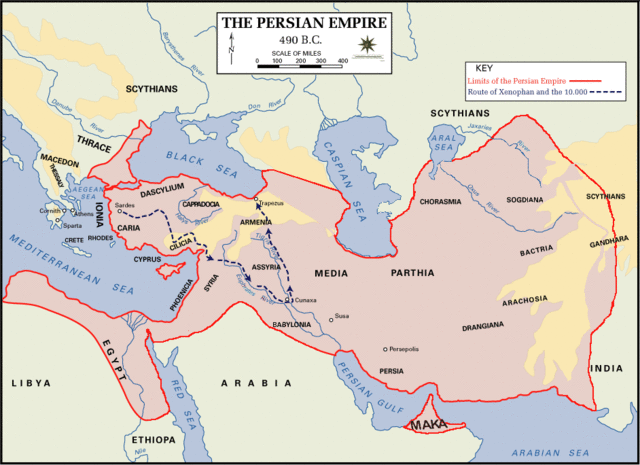
Ancient Wars: Sparta - World Forge Legends v.1.10f - Game mod - Download. The file World Forge Legends v.1.10f is a modification for Ancient Wars: Sparta, a(n) strategy game. Download for free. File type Game mod. File size 1682.5 MB. Last update Sunday, February 2, 2020. Downloads 2619. Downloads (7 days) 30. Ancient Wars: Sparta. World Forge Play Ten Interactive Released 2007. Ancient Wars: Sparta is a RTS which takes place during 500-450 BC period, which recreates the battles of Spartans, Persians and Egyptians for Little Asia, Europe and North Africa. The single player campaign is divided between the 3 aforementioned races totalling 27 missions.
Spartans would humiliate the Helots by doing such things as forcing them to get debilitatingly drunk on wine and then make fools of themselves in public. (This practice was also intended to demonstrate to young people how an adult Spartan should never act, as self-control was a prized trait.) Methods of mistreatment could be far more extreme: Spartans were allowed to kill Helots for being too smart or too fit, among other reasons. The Spartan MilitaryUnlike such Greek city-states as Athens, a center for the arts, learning and philosophy, Sparta was centered on a warrior culture. Male Spartan citizens were allowed only one occupation: solider. Indoctrination into this lifestyle began early.
Spartan boys started their military training at age 7, when they left home and entered the Agoge. The boys lived communally under austere conditions. They were subjected to continual physical, competitions (which could involve violence), given meager rations and expected to become skilled at stealing food, among other survival skills.
The teenage boys who demonstrated the most leadership potential were selected for participation in the Crypteia, which acted as a secret police force whose primary goal was to terrorize the general Helot population and murder those who were troublemakers. At age 20, Spartan males became full-time soldiers, and remained on active duty until age 60.The Spartans’ constant military drilling and discipline made them skilled at the ancient Greek style of fighting in a phalanx formation. In the phalanx, the army worked as a unit in a close, deep formation, and made coordinated mass maneuvers.
No one soldier was considered superior to another. Going into battle, a Spartan soldier, or hoplite, wore a large bronze helmet, breastplate and ankle guards, and carried a round shield made of bronze and wood, a long spear and sword. Spartan warriors were also known for their long hair and red cloaks.
Spartan Women and MarriageSpartan women had a reputation for being independent-minded, and enjoyed more freedoms and power than their counterparts throughout ancient Greece. While they played no role in the military, female Spartans often received a formal education, although separate from boys and not at boarding schools. In part to attract mates, females engaged in athletic competitions, including javelin-throwing and wrestling, and also sang and danced competitively. As adults, Spartan women were allowed to own and manage property.
Additionally, they were typically unencumbered by domestic responsibilities such as cooking, cleaning and making clothing, tasks which were handled by the helots. Marriage was important to Spartans, as the state put pressure on people to have male children who would grow up to become citizen-warriors, and replace those who died in battle. Men who delayed marriage were publically shamed, while those who fathered multiple sons could be rewarded.In preparation for marriage, Spartan women had their heads shaved; they kept their hair short after they wed. Married couples typically lived apart, as men under 30 were required to continue residing in communal barracks. In order to see their wives during this time, husbands had to sneak away at night. Decline of the SpartansIn 371 B.C., Sparta suffered a catastrophic defeat at the hands of the Thebans at the Battle of Leuctra. In a further blow, late the following year, Thebangeneral Epaminondas (c.418 B.C.-362B.C.)led an invasion into Spartan territory and oversaw the liberation of the Messenian Helots, who had been enslaved by the Spartans for several centuries.
The Spartans would continue to exist, although as a second-rate power in a long period of decline. In 1834,Otto (1815-67), the king of Greece, ordered thefounding of the modern-daytown of Spartion the site of ancient Sparta.

Ancient Wars: Sparta is based upon Mediterranean historical events that took place between 500 and 450 B.C. Single-players entering the campaign must take the role of three different nationalities as they attempt to complete the game. Playing as the Spartans, Egyptians, and Persians, gamers must battle through a variety of scenarios as they struggle to maintain control of Little Asia, Europe, and North Africa.
Combat is only a part of the game, and to keep armies happy in the field players must produce food, armor, and shelter for their boys in uniform. Each faction has its own strengths and weakness, such as the Persians ability to bring animals to battle, and gamers can upgrade their skills through research and development. Players who want a quick skirmish can select a side and then engage in a single mission.
Through a LAN or the Internet, gamers can challenge international competitors or neighborhood friends to an altered version of ancient history.Ancient Wars - Sparta is tactically riding the crest of popularity the film 300 conjured. Chronicling the plight of the Spartans centrally - but also the Persians and the Egyptians - although obviously their involvement in this specific conflict is especially detailed. In saying that there's plenty to wade through even though the Battle of Thermopylae is central to the game's forward thrust.Narrative aside - the story of the Battle of Thermopylae will always provoke interest - on the surface there's a lot about Ancient Wars - Sparta to be uninspired about. You're expected to construct a settlement, houses for your villagers, farms to feed them, barracks for your military units, etc.
There's nothing setting this apart from the usual paint-by-numbers approach to resource building, even the genre's heavyweights are built on the same foundations. The difference here being Sparta takes a standardized middle ground strategy toward resource management rather than the monolithic overwhelming experience seen in Supreme Commander. However, Supreme's gargantuan number of units was something of a pock on an otherwise un-blemished face. Ancient Wars - SpartaAncient Wars: Sparta has only three types of infantry, or so it may seem. While the number of on screen infantry doesn't compare favorably to Supreme Commander this is a much more intricate affair. Each soldier can be adjusted, equipped and reequipped to suit the situation at hand. Different weapons offer tactical advantages and disadvantages depending on the situation.
Give the unit (formally a peasant that transforms into a military unit once given a weapon) a long spear and a shield and he'll have the long distance attacking and a defensive capability. Or give him two short swords and he'll go on a frenzied attack-is-the-best-form-of-defense type rampage. In reality he'll be dropped fairly quickly, but not before making an impact.
The best type of unit depends on what job you need doing at that given time. Due to the number of weapons available the sheer volume of different units that can be created with different types of effectiveness is something to marvel at. The game lets you decide what works and what doesn't without a hold-your-hand tutorial. You can build a stable that produces horses, these only become cavalry once a soldier has been placed upon them, any soldier.However despite this massively in-depth unit tinkermanship (a great niche for developer World Forge) the game offers nothing like the tactical challenge you might expect.
Disappointingly, considering the potential, the conflict in Sparta falls into the vat of familiarity where the side with the most units wins. However this is where the future of RTS gaming lies, where each troop can be individually manipulated, where the way you equip your army is as important as how you use them in battle. Ancient Wars hasn't pulled this off, but it has laid a blueprint for other developers to build upon.Otherwise, Sparta is a pretty average, no-frills affair.
The game works, but on a basic level. The graphics are well below what we've grown to expect - offering an 'in close' perspective that makes it difficult to plan strategically, but does give visual detail to units. There's a waypoint system that displays objectives on the map, something Age of Empires did 10 years ago. The sound is bad and the AI is abominable in places; the repetitive nature of all NPCs drives you to distraction. You'll also lose units as they go on an illogical walkabout round the hills when a leisurely stroll down the path would suffice. Worst still as this carries through to the voice-overs that are repeated over and over with little by the way of variation.Unit pathfinding is not as bright as you might like either, with soldiers taking ineffective routes at times. The enemies meanwhile do not think through their actions at all, nor do they use any tactics more complicated than 'Charge!'
The multiplayer offers relief from the beyond-basic AI, but then with RTS games dripping out of our ears, Ancient Wars simply offers nothing more than any other game and indeed falls far short of the kind of experience offered by the big genre contenders. Although, in an attempt to rescue a small shred of dignity for the game, it must be noted that sea battles are quite pleasing to play, offering a nice change from land-based combat. Ancient Wars - SpartaThe three campaigns on offer, where you fight as one of the primary factions, are moderately well built, with a little bit of variety to discover as you progress. However, you soon fall into old routines of resource management, base building and churning out the warriors. Your army will grow with all the speed of a legless sloth, thanks to the interminable build times and the general sluggishness of the game mechanics.
This is acceptable if you enjoy taking your time, spending many hours on some battles, but most RTS devotees are used to more celeritous affairs, testing their nerves and quick-wittedness.Most importantly, ancient Sparta and Persia were not just common fighting forces. They were trained war machines, both unique and highly effective in what they did. Their leaders were cunning and clever, using mixed force armies and innovative tactical stratagems to accomplish their aims. The history books are full of astounding tales from these nations and Sparta in particular deserves an amazing game conversion after such a successful film adaptation - I'm sure many developers are out there right now, dreaming of exotic and wonderful ways in which to digitally realize the full glory of Sparta and its awe-inspiring people.
Yet playing Ancient Wars, you get no such feeling; it's as bland and by-the-numbers as any other generic RTS.Will you gain much enjoyment from Ancient Wars: Sparta? That depends on whether you play it for a simple RTS fix, or for the value of the civilizations and subject material it covers. For a brief play it serves a purpose well enough, but if you really want to get the most out of this exciting period of ancient combat then you'll want to wait until something more inspired comes along, because Ancient Wars is just a bit too spartan to give you the experience that you are hoping for.Some quality is salvaged through the navy battles, although this often feels like an add-on to the main game.
It's fun, but repetitive and worthy of little more than passing comment. Ancient Wars - SpartaGiven the intriguing nature of the narrative and the potential for development in such a plot, it's surprising to see such a bland title. 300 offered a glimpse of what could have been created with a little imagination and it is a shame that Ancient Wars - Sparta, despite the innovative unit management system, fails to deliver overall.People who downloaded Ancient Wars: Sparta have also downloaded:,©2020 San Pedro Software Inc. Contact:, done in 0.004 seconds.
Accounting Principles
| Part of a series on |
| Accounting |
|---|
|
|

A principle is objective to the extent that the accounting information is not influenced by personal bias or judgment of those who provide it. It also implies verifiability which means that there is some way of ascertaining the correctness of the information reported. Accounting follows a certain framework of core principles which makes the information generated through an accounting system valuable. Without these core principles accounting information such as balance sheet and income statement of a company would be irrelevant and unreliable and irrelevant.
Generally Accepted Accounting Principles (GAAP or U.S. GAAP) is the accounting standard adopted by the U.S. Securities and Exchange Commission (SEC). While the SEC previously stated that it intends to move from U.S. GAAP to the International Financial Reporting Standards (IFRS), the latter differ considerably from GAAP and progress has been slow and uncertain.[1][2] More recently, the SEC has acknowledged that there is no longer a push to move more U.S companies to IFRS so the two sets of standards will 'continue to coexist' for the foreseeable future.[3]
The Financial Accounting Standards Board (FASB) published U.S. GAAP in Extensible Business Reporting Language (XBRL) beginning in 2008.
History[edit]
Auditors took the leading role in developing GAAP for business enterprises.[4]
Accounting standards have historically been set by the American Institute of Certified Public Accountants (AICPA) subject to U.S. Securities and Exchange Commission (SEC) regulations.[5] The AICPA first created the Committee on Accounting Procedure in 1939 and replaced that with the Accounting Principles Board in 1959. In 1973, the Accounting Principles Board was replaced by the Financial Accounting Standards Board (FASB) under the supervision of the Financial Accounting Foundation with the Financial Accounting Standards Advisory Council serving to advise and provide input on the accounting standards.[6] Other organizations involved in determining United States accounting standards include the Governmental Accounting Standards Board (GASB), formed in 1984; and the Federal Accounting Standards Advisory Board (FASAB), formed in 1990.[7]
Circa 2008, the FASB issued the FASB Accounting Standards Codification, which reorganized the thousands of U.S. GAAP pronouncements into roughly 90 accounting topics.[8]
In 2008, the Securities and Exchange Commission issued a preliminary 'roadmap' that may lead the United States to abandon Generally Accepted Accounting Principles in the future, and to join more than 100 countries around the world instead in using the London-based International Financial Reporting Standards.[9] As of 2010, the convergence project was underway with the FASB meeting routinely with the IASB.[10] The SEC expressed their aim to fully adopt International Financial Reporting Standards in the U.S. by 2014.[11] With the convergence of the U.S. GAAP and the international IFRS accounting systems, as the highest authority over International Financial Reporting Standards, the International Accounting Standards Board is becoming more important in the United States.
Basic characteristic[edit]
Financial reporting should provide information that is:
- Useful to present to potential investors and creditors and other users in making rational investment, credit, and other financial decisions
- Helpful to present to potential investors and creditors and other users in assessing the amounts, timing, and uncertainty of prospective cash receipts about economic resources, the claims to those resources, and the changes in them
- Helpful for making financial decisions
- Helpful in making long-term decisions
- Helpful in improving the performance of the business
- Useful in maintaining records
Required departures from GAAP[edit]
Under the AICPA's Code of Professional Ethics under Rule 203 – Accounting Principles, a member must depart from GAAP if following it would lead to a material misstatement on the financial statements, or otherwise be misleading. In the departure, the member must disclose, if practical, the reasons why compliance with the accounting principle would result in a misleading financial statement. Under Rule 203-1-Departures from Established Accounting Principles, the departures are rare, and usually take place when there is new legislation, the evolution of new forms of business transactions, an unusual degree of materiality, or the existence of conflicting industry practices.[12]
Involved in development[edit]
These organizations influence the development of GAAP in the United States.
- United States Securities and Exchange Commission (SEC)
- The SEC was created as a result of the Great Depression. At that time there was no structure setting accounting standards. The SEC encouraged the establishment of private standard-setting bodies through the AICPA and later the FASB, believing that the private sector had the proper knowledge, resources, and talents. The SEC works closely with various private organizations setting GAAP, but does not set GAAP itself.
- American Institute of Certified Public Accountants (AICPA)
- In 1939, urged by the SEC, the AICPA appointed the Committee on Accounting Procedure (CAP). During the years 1939 to 1959 CAP issued 51 Accounting Research Bulletins that dealt with a variety of timely accounting problems. However, this problem-by-problem approach failed to develop the much needed structured body of accounting principles. Thus, in 1959, the AICPA created the Accounting Principles Board (APB), whose mission it was to develop an overall conceptual framework. It issued 31 opinions and was dissolved in 1973 for lack of productivity and failure to act promptly. After the creation of the FASB, the AICPA established the Accounting Standards Executive Committee (AcSEC). It publishes:
- Audit and Accounting Guidelines, which summarizes the accounting practices of specific industries (e.g. casinos, colleges, airlines, etc.) and provides specific guidance on matters not addressed by FASB or GASB.
- Statements of Position, which provides guidance on financial reporting topics until the FASB or GASB sets standards on the issue.
- Practice Bulletins, which indicate the AcSEC's views on narrow financial reporting issues not considered by the FASB or the GASB.
- In 1939, urged by the SEC, the AICPA appointed the Committee on Accounting Procedure (CAP). During the years 1939 to 1959 CAP issued 51 Accounting Research Bulletins that dealt with a variety of timely accounting problems. However, this problem-by-problem approach failed to develop the much needed structured body of accounting principles. Thus, in 1959, the AICPA created the Accounting Principles Board (APB), whose mission it was to develop an overall conceptual framework. It issued 31 opinions and was dissolved in 1973 for lack of productivity and failure to act promptly. After the creation of the FASB, the AICPA established the Accounting Standards Executive Committee (AcSEC). It publishes:
- Financial Accounting Standards Board (FASB)
- Realizing the need to reform the APB, leaders in the accounting profession appointed a Study Group on the Establishment of Accounting Principles (commonly known as the Wheat Committee for its chair Francis Wheat). This group determined that the APB must be dissolved and a new standard-setting structure is created. This structure is composed of three organizations: the Financial Accounting Foundation (FAF, it selects members of the FASB, funds and oversees their activities), the Financial Accounting Standards Advisory Council (FASAC), and the major operating organization in this structure the Financial Accounting Standards Board (FASB). FASB previously had 4 major types of publications:
- Statements of Financial Accounting Standards – the most authoritative GAAP setting publications. 168 standard has been issued before the New codification.
- Statements of Financial Accounting Concepts – first issued in 1978. They are part of the FASB's conceptual framework project and set forth fundamental objectives and concepts that the FASB use in developing future standards. However, they are not a part of GAAP. There have been 7 concepts published to date.
- Interpretations – modify or extend existing standards. There have been around 50 interpretations published to date.
- Technical Bulletins or Staff Positions – guidelines on applying standards, interpretations, and opinions. Usually solves some very specific accounting issue that will not have a significant, lasting effect.
- In 1984 the FASB created the Emerging Issues Task Force (EITF) which deals with new and unusual financial transactions that have the potential to become common (e.g. accounting for Internet-based companies). It acts more like a problem filter for the FASB – the EITF deals with short-term, quickly resolvable issues, leaving long-term, more pervasive problems for the FASB.
- However, now all GAAP resides in the ASC (Accounting Standards Codification) so the FASB and EITF do not issue new standards but rather updates to the Codification. The Concepts statements still exist outside of the ASC but are not authoritative.
- Realizing the need to reform the APB, leaders in the accounting profession appointed a Study Group on the Establishment of Accounting Principles (commonly known as the Wheat Committee for its chair Francis Wheat). This group determined that the APB must be dissolved and a new standard-setting structure is created. This structure is composed of three organizations: the Financial Accounting Foundation (FAF, it selects members of the FASB, funds and oversees their activities), the Financial Accounting Standards Advisory Council (FASAC), and the major operating organization in this structure the Financial Accounting Standards Board (FASB). FASB previously had 4 major types of publications:
- Governmental Accounting Standards Board (GASB)
- Created in 1984, the GASB addresses state and local government reporting issues. Its structure is similar to that of the FASB's, and the FASB and GASB are located together and share resources.
- Other influential organizations: The Government Finance Officer's Association (GFOA) also influences financial policies for governments (disagreements between the GFOA and GASB are rare, but can continue for many years); American Accounting Association, Institute of Management Accountants, Financial Executives Institute.
Precedence of GAAP-setting authorities[edit]
In the United States, GAAP derives, in order of importance, from:
- issuances from an authoritative body designated by the American Institute of Certified Public Accountants(AICPA) Council (for example, the Financial Accounting Standards Board Statements, AICPA Accounting Principles Board Opinions, and AICPA Accounting Research Bulletins);
- other AICPA issuances such as AICPA Industry Guides;
- industry practice; and
- into para-accounting literature in the form of books and articles.
Codification in Accounting – FASB Accounting Standards Codification[edit]
The Codification is effective for interim and annual periods ending after September 15, 2009. All existing accounting standards documents are superseded as described in FASB Statement No. 168, The FASB Accounting Standards Codification and the Hierarchy of Generally Accepted Accounting Principles. All other accounting literature not included in the Codification is nonauthoritative.
The Codification reorganizes the thousands of U.S. GAAP pronouncements into roughly 90 accounting topics and displays all topics using a consistent structure. It also includes relevant Securities and Exchange Commission (SEC), guidance that follows the same topical structure in separate sections in the Codification.
To prepare users for the change, the AICPA[13] has provided a number of tools and training resources.
While the Codification does not change GAAP, it introduces a new structure—one that is organized in an easily accessible, user-friendly online research system. The FASB expects that the new system will reduce the amount of time and effort required to research an accounting issue, mitigate the risk of noncompliance with standards through improved usability of the literature, provide accurate information with real-time updates as new standards are released, and assist the FASB with the research efforts required during the standard-setting process.
See also[edit]
- Statutory accounting principles for US insurance companies
Notes[edit]
- ^'IFRS: Current situation and next steps', pwc.com
- ^'New mechanisms eyed by FASB, IASB in long march toward global comparability', Ken TysiacJanuary 10, 2013, journalofaccountancy.com
- ^'A U.S. Imperative: High-Quality, Globally Accepted Accounting Standards', SEC January 5, 2017, sec.gov
- ^Gauthier, Stephen J. Governmental Accounting, Auditing, and Financial Reporting.
- ^Financial Accounting Standards. QuickMBA.
- ^Financial Accounting Standards Advisory Council (FASAC). FASB FASAC.
- ^'History of FASAB'. fasab.gov.
- ^AICPA (February 2008). 'AICPA Applauds FASB's Issuance of GAAP Codification'. The CPA Letter.Cite journal requires
|journal=(help) - ^Crovitz, L. Gordon (2008-09-08). 'Closing the Information GAAP'. The Wall Street Journal. Retrieved 2008-09-24.
- ^Progress Report on Commitment to Convergence of Accounting Standards—June 24, 2010. FASB.
- ^Jeffers, Agatha; Mengyu Wei; Sidney Askew (2010). 'The Switch from U.S. GAAP to IFRS'. Proceedings of the Northeast Business & Economics Association: 48–54.
- ^Page 56. 'Auditing, an integrated approach' by Alvin Arens and James Loebbecke, published in 1980 by Prentise Hall, ISBN0-13-051656-2.
- ^'FASB Accounting Standards Codification', Deloitte Global Services Limited, 2009, retrieved April 30, 2016
External links[edit]
| Library resources about Generally Accepted Accounting Principles (United States) |
- SEC Accounting Bulletins – United States
- SEC Division of Corporate Finance – United States
- Financial Accounting Standards Board Website (FASB) – United States
- Government Accounting Standards Board Website (GASB) – United States
- US GAAP XBRL Taxonomy – United States
Retrieved from 'https://en.wikipedia.org/w/index.php?title=Generally_Accepted_Accounting_Principles_(United_States)&oldid=942323215'
War Of Nations Hints Today

Holy War: It's Waged by More Nations Than You Think. And I think that both of these tremendously powerful times in Jewish history shape their world view today. Masada is used as an example of.
This summer marks 100 years since the guns of August 1914 signaled the eruption of an unprecedented global battle. Over the next four years, some two dozen countries would send more than 60 million soldiers to fight.
When the guns at last fell silent in November 1918, 10 million men had fallen, and millions more were permanently maimed. Some 7 million civilians had also died, and the physically broken and psychologically scarred were beyond counting.Shocked by its magnitude, its duration, and above all by its staggering human cost, contemporaries labeled the conflict simply the 'Great War.' In a historical tour de force, Baylor University's Philip Jenkins demonstrates that participants viewed it as a holy war as well.
The story Jenkins faithfully retells in The Great and Holy War: How World War I Became a Religious Crusade (HarperOne) is both engaging and disturbing.Jenkins's central point is that we cannot comprehend World War I until we come to grips with its essential religious dimension. Religion is central to 'understanding the war, to understanding why people went to war, what they hoped to achieve through war, and why they stayed at war.' Just as important were the long-term religious consequences. The war triggered 'a global religious revolution,' Jenkins argues, and in the process 'drew the world's religious map as we know it today.' 'Hell against Heaven'Holy war' is a loaded phrase, and Jenkins is careful to define what he means by it. It goes far beyond what theologians such as Augustine of Hippo and Thomas Aquinas meant by 'just war.'
Just-war doctrine says that, in a fallen world, as a last resort one fallen nation may.
UN peacekeepers in the Democratic Republic of the Congo
Saving future generations from the scourge of war was the main motivation for creating the United Nations, whose founders lived through the devastation of two world wars. Since its creation, the UN has often been called upon to prevent disputes from escalating into war, or to help restore peace following the outbreak of armed conflict, and to promote lasting peace in societies emerging from wars.
Security Council
Over the decades, the UN has helped to end numerous conflicts, often through actions of the Security Council — the organ with primary responsibility, under the United Nations Charter, for the maintenance of international peace and security. When it receives a complaint about a threat to peace, the Council first recommends that the parties seek an agreement by peaceful means. In some cases, the Council itself investigates and mediates. It may appoint special representatives or request the Secretary-General to do so, or to use his good offices. It may set forth principles for a peaceful settlement.
When a dispute leads to fighting, the Council's first concern is to end it as soon as possible. On many occasions, the Council has issued ceasefire directives, which have helped to prevent major hostilities. It also deploys UN peacekeeping operations to reduce tensions in troubled areas, keep opposing forces apart, and create conditions for sustainable peace after settlements have been reached. The Council may decide on enforcement measures, economic sanctions (such as trade embargoes) or collective military action.
General Assembly
According to the Charter, the General Assembly can make recommendations on the general principles of cooperation for maintaining international peace and security, including disarmament, and for the peaceful settlement of any situation that might impair friendly relations among nations. The General Assembly may also discuss any question relating to international peace and security and make recommendations the Security Council is not currently discussing the issue.
Pursuant to its “Uniting for Peace” resolution of November 1950 (resolution 377 (V)), the General Assembly may also take action if the Security Council fails to act, owing to the negative vote of a Permanent Member, in a case where there appears to be a threat to, or breach of peace, or an act of aggression. The Assembly can consider the matter immediately in order to make recommendations to Members for collective measures to maintain, or restore, international peace and security.
Secretary-General
The Charter empowers the Secretary-General to 'bring to the attention of the Security Council any matter which in his opinion may threaten the maintenance of international peace and security.' One of the most vital roles played by the Secretary-General is the use of his 'good offices' – steps taken publicly and in private that draw upon his independence, impartiality and integrity to prevent international disputes from arising, escalating or spreading.
Conflict Prevention
The main strategies to prevent disputes from escalating into conflict, and to prevent the recurrence of conflict, are preventive diplomacy and preventive disarmament. Preventive diplomacy refers to action taken to prevent disputes from arising or escalating into conflicts, and to limit the spread of conflicts as they arise. It may take the form of mediation, conciliation or negotiation.
Preventive diplomacy
Early warning is an essential component of prevention, and the United Nations carefully monitors developments around the world to detect threats to international peace and security, thereby enabling the Security Council and the Secretary-General to carry out preventive action. Envoys and special representatives of the Secretary-General are engaged in mediation and preventive diplomacy throughout the world. In some trouble spots, the mere presence of a skilled envoy can prevent the escalation of tension. These envoys often cooperate with regional organizations.
Preventive disarmament
Complementing preventive diplomacy is preventive disarmament, which seeks to reduce the number of small arms in conflict-prone regions. In El Salvador, Liberia, Sierra Leone, Timor-Leste and elsewhere, this has entailed demobilizing combat forces, as well as collecting and destroying their weapons as part of an overall peace agreement. Destroying yesterday’s weapons prevents their use in tomorrow’s wars.
Preventing Genocide and Responsibility to Protect
Prevention requires apportioning responsibility and promoting collaboration between the concerned States and the international community. The duty to prevent and halt genocide and mass atrocities lies first and foremost with the State, but the international community has a role that cannot be blocked by the invocation of sovereignty. Sovereignty no longer exclusively protects States from foreign interference; it is a charge of responsibility where States are accountable for the welfare of their people. This principle is enshrined in article 1 of the Genocide Convention and embodied in the principle of “sovereignty as responsibility” and in the concept of the Responsibility to Protect.
The Special Adviser on the Prevention of Genocide acts as a catalyst to raise awareness of the causes and dynamics of genocide, to alert relevant actors where there is a risk of genocide, and to advocate and mobilize for appropriate action. The Special Adviser on the Responsibility to Protect leads the conceptual, political, institutional and operational development of the Responsibility to Protect. The efforts of their Office include alerting relevant actors to the risk of genocide, war crimes, ethnic cleansing and crimes against humanity, enhancing the capacity of the United Nations to prevent these crimes, including their incitement.
Peacekeeping
United Nations peacekeeping operations are a vital instrument employed by the international community to advance peace and security.
The first UN peacekeeping mission was established in 1948 when the Security Council authorized the deployment of the United Nations Truce Supervision Organization (UNTSO) to the Middle East to monitor the Armistice Agreement between Israel and its Arab neighbours. Since then, there have been more than 70 UN peacekeeping operations around the world.
Over 70 years, UN peacekeeping has evolved to meet the demands of different conflicts and a changing political landscape. Born at the time when Cold War rivalries frequently paralyzed the Security Council, UN peacekeeping goals were primarily limited to maintaining ceasefires and stabilizing situations on the ground, so that efforts could be made at the political level to resolve the conflict by peaceful means.
UN peacekeeping expanded in the 1990s, as the end of the Cold War created new opportunities to end civil wars through negotiated peace settlements. Many conflicts ended, either through direct UN mediation, or through the efforts of others acting with UN support. Countries assisted included El Salvador, Guatemala, Namibia, Cambodia, Mozambique, Tajikistan, and Burundi. In the late nineties, continuing crises led to new operations in the Democratic Republic of the Congo, the Central African Republic, Timor Leste, Sierra Leone and Kosovo.
In the new millennium, peacekeepers have been deployed to Liberia, Côte d'Ivoire, Sudan, South Sudan, Haiti, and Mali.
Today's conflicts are less numerous but deeply rooted. For example, the Democratic Republic of the Congo, Darfur, and South Sudan today, are in a second or third wave of conflict. And many are complicated by regional dimensions that are key to their solution. In fact, some two-thirds of peacekeeping personnel today are deployed amid ongoing conflict, where peace agreements are shaky or absent. Conflicts today are also increasingly intensive, involving determined armed groups with access to sophisticated armaments and techniques.
The nature of conflict has also changed over the years. UN peacekeeping, originally developed as a means of resolving inter-State conflict, has been increasingly applied over time to intra-State conflicts and civil wars. Although the military remains the backbone of most peacekeeping operations, today’s peacekeepers perform a variety of complex tasks, from helping to build sustainable institutions of governance, through human rights monitoring and security sector reform, to the disarmament, demobilization and reintegration of former combatants, and demining.
Peacebuilding
Within the United Nations, peacebuilding refers to efforts to assist countries and regions in their transitions from war to peace and to reduce a country's risk of lapsing or relapsing into conflict by strengthening national capacities for conflict management, and laying the foundations for sustainable peace and development.
Building lasting peace in war-torn societies is a daunting challenge for global peace and security. Peacebuilding requires sustained international support for national efforts across the broadest range of activities. For instance, peacebuilders monitor ceasefires, demobilize and reintegrate combatants, assist the return of refugees and displaced persons, help to organize and monitor elections of a new government, support justice and security sector reforms, enhance human rights protections, and foster reconciliation after past atrocities.
Peacebuilding involves action by a wide array of organizations of the UN system, including the World Bank, regional economic commissions, NGOs and local citizens’ groups. Peacebuilding has played a prominent role in UN operations in Bosnia and Herzegovina, Cambodia, El Salvador, Guatemala, Kosovo, Liberia and Mozambique, as well as more recently in Afghanistan, Burundi, Iraq, Sierra Leone and Timor-Leste. An example of inter-state peacebuilding has been the UN Mission in Ethiopia and Eritrea.
Recognizing that the UN needs to better anticipate and respond to the challenges of peacebuilding, the 2005 World Summit approved the creation of a new Peacebuilding Commission. In the resolutions establishing the Peacebuilding Commission, resolution 60/180 and resolution 1645 (2005), the UN General Assembly and the Security Council mandated it to bring together all relevant actors to advise on the proposed integrated strategies for post-conflict peacebuilding and recovery; to marshal resources and help ensure predictable financing for these activities; and to develop best practices in collaboration with political, security, humanitarian and development actors.
The resolutions also identify the need for the Commission to extend the period of international attention on post-conflict countries, and where necessary, highlight any gaps which threaten to undermine peacebuilding.


The General Assembly and Security Council resolutions establishing the Peacebuilding Commission also provided for the establishment of a Peacebuilding Fund and a Peacebuilding Support Office.
The Rule of Law
Promoting the rule of law at the national and international levels is at the heart of the United Nations’ mission. Establishing respect for the rule of law is fundamental to achieving a durable peace in the aftermath of conflict, to the effective protection of human rights, and to sustained economic progress and development. The principle that everyone – from the individual to the State itself – is accountable to laws that are publicly promulgated, equally enforced and independently adjudicated, is a fundamental concept which drives much of the United Nations work. The main United Nations organs, including the General Assembly and the Security Council, play essential roles in supporting Member States to strengthen the rule of law, as do many United Nations entities.
Responsibility for the overall coordination of rule of law work by the United Nations system rests with the Rule of Law Coordination and Resource Group, chaired by the Deputy Secretary-General and supported by the Rule of Law Unit. Members of the Group are the principals of 20 United Nations entities engaged in supporting Member States to strengthen the rule of law. Providing support from headquarters to rule of law activities at the national level, the Secretary-General designated the Department of Peacekeeping Operations (DPKO) and the United Nations Development Programme (UNDP) as the joint global focal point for the police, justice and corrections areas in the rule of law in post-conflict and other crisis situations.
Demining
In 2014, landmines and explosive hazards killed approximately 10 people every day — most of them children, women and the elderly — and severely maim countless more. Scattered in some 57 countries and 4 territories, landmines and other explosive hazards are an ongoing reminder of conflicts which have been over for years or even decades.
The UN aims for a world free of landmines and explosive remnants of war, where individuals and communities live in a safe environment conducive to development and where the needs of victims are met. Twelve UN Departments and Offices of the Secretariat, specialized agencies, funds and programmes play a role in mine-action programs in 30 countries and three territories.
Mine action makes it possible for peacekeepers to carry out patrols, for humanitarian agencies to deliver assistance, and for ordinary citizens to live without the fear that a single misstep could cost them their lives.
Mine action entails more than removing landmines from the ground. It includes high impact efforts aimed at protecting people from danger, helping victims become self-sufficient and active members of their communities.
A jointly developed policy is the 'Mine Action and Effective Coordination: the United Nations Inter-Agency Policy'. It guides the division of labour within the United Nations. Much of the actual work, such as demining and mine risk education, is carried out by nongovernmental organizations. Commercial contractors and, in some situations, militaries, add humanitarian mine-action services to this. Furthermore, a variety of intergovernmental, international and regional organizations, as well as international financial institutions, fund operations and provide services to individuals and communities affected by landmines and explosive remnants of war.
The UN Mine Action Service (UNMAS) coordinates the UN's mine-related activities. UNMAS ensures an effective, proactive and coordinated response to the problems of landmines and explosive remnants of war, including cluster munitions. It assesses and monitors the threat posed by mines and unexploded ordnance on an ongoing basis and develops policies and standards. The Service mobilizes resources, and advocates in support of the global ban on anti-personnel landmines. UNMAS sets up and manages mine-action coordination centres in countries and territories as part of peacekeeping operations, humanitarian emergencies and crises. More recently, UNMAS has increasingly focused on the threat posed by improvised explosive devices.
The UN has addressed the problems posed by landmines since the 1980s. It acted decisively to address the use of weapons having indiscriminate effects when it sponsored the 1980 Convention on Certain Conventional Weapons. In 1996, that Convention was strengthened to include the use of landmines in internal conflicts and to require that all mines be detectable.
Eventually, a growing public outcry, combined with the committed action of non-governmental organizations involved in the International Campaign to Ban Land Mines (ICBL), led to the adoption of a comprehensive global agreement.
The landmark 1997 UN Convention on the Prohibition of the Use, Stockpiling, Production and Transfer of Anti-personnel Mines and on Their Destruction (Mine-Ban Convention) bans the production, use and export of these weapons and has nearly universal support. As of November 2016, it had 162 States parties.
A UN International Day for Mine Awareness and Assistance in Mine Action is observed every year on 4 April.
In 2015, the UN Secretary-General designated the renowned actor Daniel Craig as the first UN Global Advocate for the Elimination of Mines and Explosive Hazards.
Women and Children in Conflict
In contemporary conflicts, up to 90 per cent of casualties are civilians, mostly women and children. Women in war-torn societies can face specific and devastating forms of sexual violence, which are sometimes deployed systematically to achieve military or political objectives. Moreover, women continue to be poorly represented in formal peace processes, although they contribute in many informal ways to conflict resolution.
However, the UN Security Council in its resolution 1325 on women, peace and security has recognized that including women and gender perspectives in decision-making can strengthen prospects for sustainable peace. The landmark resolution addresses the situation of women in armed conflict and calls for their participation at all levels of decision-making on conflict resolution and peacebuilding.
Since the agenda was set with the core principles of resolution 1325, the Security Council adopted three supporting resolutions — 1820, 1888 and 1889. All four resolutions focus on two key goals: strengthening women’s participation in decision-making and ending sexual violence and impunity.
Since 1999, the systematic engagement of the UN Security Council has firmly placed the situation of children affected by armed conflict as an issue affecting peace and security. The Security Council has created a strong framework and provided the Secretary-General with tools to respond to violations against children. The Special Representative of the Secretary-General for Children and Armed Conflict serves as the leading UN advocate for the protection and well-being of children affected by armed conflict.
Peaceful uses of outer space
The UN works to ensure that outer space is used for peaceful purposes and that the benefits from space activities are shared by all nations. This concern for the peaceful uses of outer space began soon after the launch of Sputnik — the first artificial satellite — by the Soviet Union in 1957 and has kept pace with advances in space technology. The UN has played an important role by developing international space law and by promoting international cooperation in space science and technology.
The Vienna-based United Nations Office for Outer Space serves as the secretariat for the Committee on the Peaceful Uses of Outer Space and its subcommittees, and assists developing countries in using space technology for development.
Resources:
Dark Alleys Penumbra Motel Collectors Edition
Top Online

Dark Alleys: Penumbra Motel Collector`s Edition Full Description During a road trip your friend's daughter is kidnapped by a mysterious man at the Penumbra Motel, the scene of murder.
Top 100 Games
HOME→ PC GAMES → HIDDEN OBJECT → DARK ALLEYS: PENUMBRA MOTEL COLLECTOR'S EDITION
by ERS G-Studio
Can you imagine what is like to have your daughter being kidnapped right in front of you? Dark Alleys: Penumbre Motel is about to make this happen. Dive into this spooky and dark story and face lots of challenges and difficult puzzles. With all its quality graphics, soundtrack, unique storyline and using real actors for the characters new game Dark Alleys: Penumbre Motel from the ERS developers is definitely worth waiting.
SCREENSHOTS
VIDEO
DARK ALLEYS: PENUMBRA MOTEL COLLECTOR'S EDITION RELATED GAMES
TRY FABULOUS PREQUELS AND SEQUELS OF DARK ALLEYS: PENUMBRA MOTEL COLLECTOR'S EDITION GAME
DARK ALLEYS: PENUMBRA MOTEL COLLECTOR'S EDITION REVIEW BY DOUBLEGAMES
If you are a great fan of the standard ERS G-Studio formula games, Dark Alleys: Penumbra Motel is a real surprise. .. Read more
Starting with the plot, Dark Alleys: Penumbra Motel dwells upon a sombre story about a missing child, your friend’s daughter, who is kidnapped by a weird man at the Penumbra Motel. So now you are heading to the one of the darkest alleys in the USA, to a place where this sinister motel is standing.
Being rather tired of one seek and find after another in some games, you will like Dark Alleys: Penumbra Motel as there are no straight hidden object scenes, but still plays like a hidden object game. The game is packed with a plethora of puzzles that are not very easy, some are even tricky. However, the hint button works properly, refilling without delay. The puzzles can be skipped but they really worth to be solved without any hints.
Dark and gloomy scenes of Dark Alleys: Penumbra Motel looks soundly though, they are not as crisp as other scenes of this developer. Anyway, items and other things are quite recognizable and clear. Music was quite creepy and suited the feel and mood of the game. While the music might sound annoying after a while, the voice-acting is well-made.
Looking for traced and trying to unravel a mystery are common for die-hard fans of Hidden Object genre. Today all these challenges are wrapped into a pretty ordinary mini-games and puzzles. Fortunately, Dark Alleys: Penumbra Motel is ready to offer you a few twists on classical gameplay. If you have nothing against something new, you will surely appreciate this title.
14, May 2012DoubleGames
COMMENTS FOR DARK ALLEYS: PENUMBRA MOTEL COLLECTOR'S EDITION
Free download Dark Alleys: Penumbra Motel Collector's Edition screenshot
xACTUAL OFFERS
Whispered Secrets: Cursed Wealth
Expires in 1584860400
Dead Reckoning: Broadbeach CoveExpires in 20 Apr 2020
FOLLOW US!
